Afinarte Digital brings together professional tools, lessons, teachers, songbooks, music history and practice resources for your computer, tablet or phone.
A clear path from posture to your first song, using the tuner, metronome and exercises right on this page.
01. Parts of the guitar
Knowing the instrument is the first step before playing a single note. The headstock is at the top of the neck and holds the six tuning pegs. Moving down, we find the fretboard, the flat surface where you press the strings against the frets.
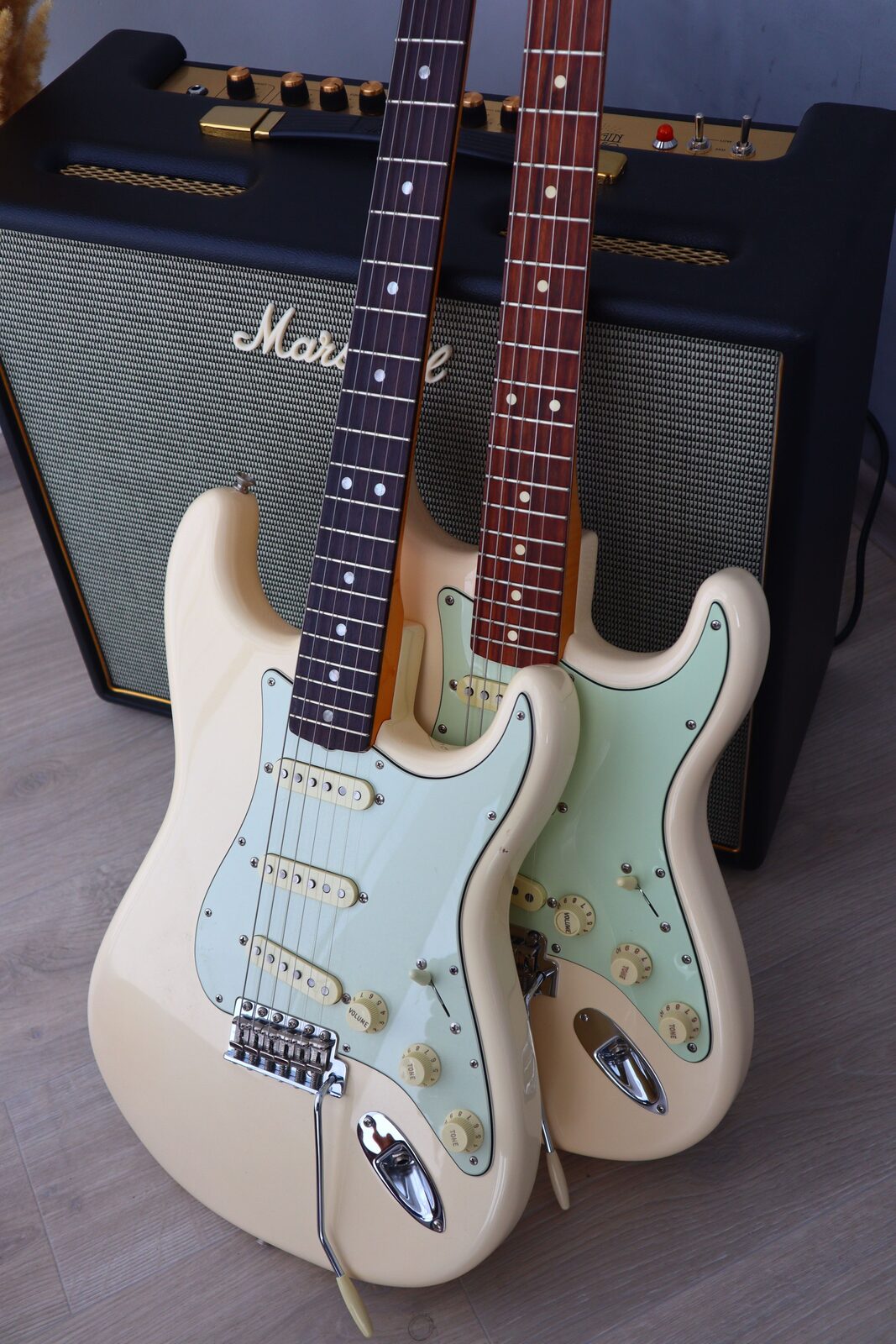
The body is the largest part: on an acoustic guitar it is a hollow wooden resonance box that amplifies the sound through the soundhole; on an electric guitar it is a solid body that relies on magnetic pickups.
Basic care: keep the guitar away from direct heat and extreme humidity, and wipe the strings with a dry cloth after each session.
02. How to hold it
Correct posture is not just an aesthetic detail. Seated, rest the guitar on your right leg for pop or folk style, or on your left leg with a raised foot if you follow the classical tradition.
Your left thumb rests behind the neck, without poking above the fretboard. Your fingers curve and press the strings with their tips just behind the fret.
When standing, a strap adjusted to a similar height saves you from having to relearn your left-hand position.
03. How to tune
Open the Tuner on this page, turn on the microphone and play a single open string. The indicator will tell you if the note is too low or too high; turn the corresponding tuning peg slowly.
Repeat the process with all six strings, always from the lowest to the highest: E - A - D - G - B - E.
If your guitar is new, it is normal to have to retune it several times during the first few days.
04. String names
In standard tuning, from the thickest string to the thinnest, the order is: E - A - D - G - B - E.
Practice naming each string out loud as you play it open, several times a day, until the order becomes automatic.
This knowledge will also help you detect by ear when a specific string is out of tune.
05. Basic chords
With just seven chords you can accompany hundreds of songs. The recommended order is: Em - Am - C - D - G - E - A.
Practice each chord separately: place your fingers, strum all six strings and listen for a clean sound.
Don't get discouraged if your fingertips hurt at first: natural calluses form within a couple of weeks.
06. Chord changes
Playing a chord isn't the hard part; changing from one to another without losing the beat is. Practice very slowly, counting out loud.
Only speed up once the change is clean.
Five minutes a day pays off more than long, irregular sessions.
07. Starter rhythms
The most basic strumming pattern combines down and up strokes: down-down-up-up-down-up.
4/4 time is the most common in popular music.
Practice the pattern alone, on the open strings, before adding chord changes.
08. First song
Once you master Em, C, G and D, practice this progression: Em - C - G - D, on a loop.
It is one of the most widely used progressions in the history of popular music.
Mastering it opens the door to recognizing and playing many other songs by ear.
09. Reading tablature
Tablature uses six lines, one per string. The numbers indicate which fret to press: a 0 means an open string.
It is read left to right. Numbers aligned vertically are played together, forming a chord.
Pair it with listening to the original song to catch the right rhythm.
Music culture
History of music and rock
A journey through the eras, bands and artists that defined each moment.
Roots
Long before rock and roll had a name, several musical currents intertwined in the southern United States. Mississippi Delta blues, born in the cotton fields and juke joints, gave voice to a generation through guitarists like Robert Johnson, whose legend of a crossroads deal still feeds the genre's mythology, and Muddy Waters, who later electrified that sound in Chicago.
In parallel, gospel from African American churches contributed the vocal power and call-and-response that rock would later inherit, with figures like Sister Rosetta Tharpe, whom many historians point to as a key precursor of rock and roll for the way she played electric guitar as early as the 1930s and 1940s.
White Appalachian country and urban rhythm and blues completed this mix, laying the harmonic and rhythmic foundations that, a decade later, would explode into a completely new genre.
1950s
By the middle of the decade, several artists took those ingredients—blues, gospel, country and rhythm and blues—and fused them into something new, fast and rebellious. Chuck Berry, nicknamed the father of rock and roll, defined the language of the electric guitar with songs like Johnny B. Goode and Maybellene, while Little Richard brought overflowing energy on piano and vocals.
Elvis Presley became the face that brought that sound, with its deep African American roots, to a mass audience, scandalizing more conservative circles with his moves on television.
Bill Haley and His Comets, with Rock Around the Clock, and Buddy Holly, with his influence on pop-rock songwriting, rounded out a scene that within a few years went from a regional curiosity to a phenomenon that sparked youth riots across Europe and the United States.
1960s
The so-called British Invasion changed the map of rock forever. The Beatles, after their historic appearance on The Ed Sullivan Show in 1964, sparked an unprecedented frenzy and within a few years went from three-minute pop songs to experimental records like Sgt. Pepper's Lonely Hearts Club Band. The Rolling Stones, The Who and The Animals carried a rawer, more blues-driven version of the same impulse.
In the United States, the counterculture movement found its soundtrack in psychedelia: Jimi Hendrix redefined what an electric guitar could do, Janis Joplin and Jim Morrison embodied the emotional intensity of live rock, and Bob Dylan showed that a song could be as powerful as a speech.
The Woodstock festival, in 1969, became the symbol of an entire generation seeking, through music, another way of understanding the world.
1970s
Rock branched off in opposite directions. Led Zeppelin, with Jimmy Page on guitar and Robert Plant on vocals, took blues-rock toward longer, more complex and heavier structures, laying the foundations of hard rock and, alongside Black Sabbath, of heavy metal. Queen, with Freddie Mercury's voice and stage charisma, showed that rock could also be theatrical and ambitious.
In reaction to what some saw as rock that had become too polished and distant, punk emerged. The Ramones in New York and the Sex Pistols in London stripped the genre of all ornament, returning to short, fast, direct songs with an attitude of total rupture.
This tension between the grandiose and the minimalist defined much of the decade, and set the stylistic foundations for everything that came after.
1980s
The decade unfolded between the glitz of Los Angeles glam metal, with bands like Guns N' Roses, whose debut album Appetite for Destruction became a phenomenon, and a much more aggressive, technical scene brewing at the same time.
Metallica, along with Megadeth, Slayer and Anthrax, collectively known as the Big Four, took the speed and distortion of punk toward thrash metal, with albums like Master of Puppets and ...And Justice for All that redefined the genre's technical demands. Iron Maiden, from the UK, contributed narrative complexity and epic arrangements.
Meanwhile, in the Seattle underground, a rawer, more disillusioned sound was quietly brewing, with bands that within a few years would give rise to grunge and once again change the course of rock.
Today
Music no longer depends on a record label or a local radio station to reach millions of people. From a bedroom, with a computer and a guitar, any musician can record, produce and publish their work on streaming platforms, reaching audiences anywhere in the world the same day.
Genres mix without the rigid borders of the past: rock coexists with reggaeton, metal with electronic music, local folk with high-fidelity digital productions.
Platforms like YouTube have also democratized learning: today you can learn guitar, study music theory or simply discover the history of rock, as you are doing right now, with nothing more than an internet connection. Afinarte Digital was born from exactly that idea: to be a modern meeting point for people who love music, wherever they are and whatever resources they have.
Songbook
Chord sheets and transposer
You can share your own versions in the Live Community. The transposition tool changes the key of the chords you type, without automatically publishing protected content.
Content submitted by users must be original, authorized or in the public domain. It may be reviewed or removed, and you can report rights issues by writing to contacto@afinartedigital.org.
Choose a root note and a scale type to see where its notes fall across the whole fretboard, and hear it played in ascending order.
Root note
Scale type
C Major
How a chord is formed on guitar
A chord is a group of notes played together. On guitar, you form one by pressing certain strings at certain frets at the same time, while the other strings ring open or are muted, and then strumming or plucking them all together.
1. Read the diagram
The vertical lines are the strings (thickest on the left). The horizontal lines are the frets. The thick top line is the headstock.
2. Place your fingers
The green dots mark where to press, and the number inside shows the finger: 1 index, 2 middle, 3 ring, 4 pinky.
3. Open or muted strings
An open circle means that string rings freely, without being pressed. An X means that string should not sound.
4. Press close to the fret
Place your finger just behind the metal fret bar, not on top of it. Press firmly, curving your other fingers so they don't touch other strings.
Tip: practice each chord separately, strumming slowly, until it sounds clean, before trying to switch between chords. Tap any card to hear the chord.
Major chords
CC major
DD major
EE major
FF major
GG major
AA major
BB major
Minor chords
CmC minor
DmD minor
EmE minor
FmF minor
GmG minor
AmA minor
BmB minor
Seventh chords
G7G seventh
C7C seventh
D7D seventh
E7E seventh
A7A seventh
B7B seventh
Capture your ideas instantly
Record riffs, rehearsals or quick ideas straight from your browser using your device's microphone. Your recordings stay available to play and download for the rest of this visit.
00:00
Tap the microphone to record
Your recordings
You don't have any recordings in this session yet.
Smart shopping
Recommended gear for musicians
If you're looking for gear to round out your music, we don't pick it at random: we publish honest, detailed comparisons on Tradumente, our sister recommendation site, with independent reviews and direct links to Amazon.
Reference image · not an exact model
Clip-on tuners
A visual reference for this type of accessory. The full comparison and recommended products are on Tradumente.
A visual reference of clips, raceways and cable management for a desk or recording space. The full guide gathers options to keep your workspace tidy and safe.
These links take you to Tradumente, a sister site of Maxtor Studio. Some of its links are Amazon affiliate links: if you buy through them, Tradumente may earn a commission, at no extra cost to you.
Teachers
Directory of virtual and in-person lessons
Afinarte Digital connects students and teachers. Payments and schedules are arranged directly between both parties.
Afinarte Digital was born from a simple passion: music, made with creativity and love, in any of its forms.
I'm a handwriting expert and programmer, with studies in philosophy, law and artificial intelligence—an unconventional path. But what truly defines me is being a guitar learner. I grew up surrounded by art: my father, Gastón, introduced me to classical music, and my mother, Narda, a short-story writer, taught me to love stories and creativity from childhood. That's where my love for the arts came from. I discovered folk music, fell in love with rock, and found in the songs of troubadours another way of telling stories.
I'm not a professional musician. I'm an admirer: of music and of those who create it. I have great musician friends whom I love and deeply admire for their art.
I was born in Chile and now live in Canada. From here I'm building Afinarte Digital with a concrete dream: to create a meeting point for musicians, learners and everything around them—a real connection, made by someone who loves music as much as you do.
Contact
Let's talk about Afinarte Digital
Write to us with questions, teacher listings, place suggestions, reports or partnership ideas.